If you commute along I-565, Highway 72, Memorial Parkway, or Highway 31, your vehicle’s suspension works overtime every single day. Between high-speed concrete expansion joints, sudden summer downpours, and seasonal potholes across North Alabama, your shocks and struts absorb thousands of impacts per mile.
Because suspension components wear out gradually rather than failing all at once, many drivers wonder how long do shocks and struts last before steering feels loose or stopping distances stretch dangerously long. Understanding their true lifespan—and recognizing early warning signs—helps keep your vehicle safe, stable, and comfortable on local roads.
Quick Answer: How Long Do Shocks and Struts Last?
On average, shocks and struts last between 50,000 and 100,000 miles (roughly 5 to 7 years). However, on Alabama roads with heavy commuter traffic, intense summer heat, and uneven pavement, many drivers need shocks and struts replacement closer to 60,000–75,000 miles. Replacing worn components on time helps prevent longer stopping distances, poor steering control and uneven tire wear.
Shocks vs. Struts: What Is the Difference?
A common question drivers ask is: Are shocks and struts the same thing? While people often use the terms interchangeably, the shocks and struts difference comes down to structural design and how they support your vehicle. Most cars and SUVs use struts on the front axle and shock absorbers on the rear, though some vehicles use struts at all four corners.
| Feature | Shocks (Shock Absorbers) | Struts |
| Primary Role | Controls spring bounce and rebound | Dampens bounce and supports vehicle weight |
| Structural Support? | No | Yes (integral to suspension structure) |
| Affects Wheel Alignment? | Usually no | Yes (requires alignment after replacement) |
| Typical Placement | Rear axle (common on trucks/SUVs) | Front axle (or all four corners on sedans) |
How Shock Absorbers Work
Shock absorbers are hydraulic cylinders designed strictly to control spring movement. Without shocks, your vehicle’s coil or leaf springs would bounce uncontrollably after hitting a bump. Shocks dampen that kinetic energy, keeping your tires planted firmly on the asphalt.
How Struts Work
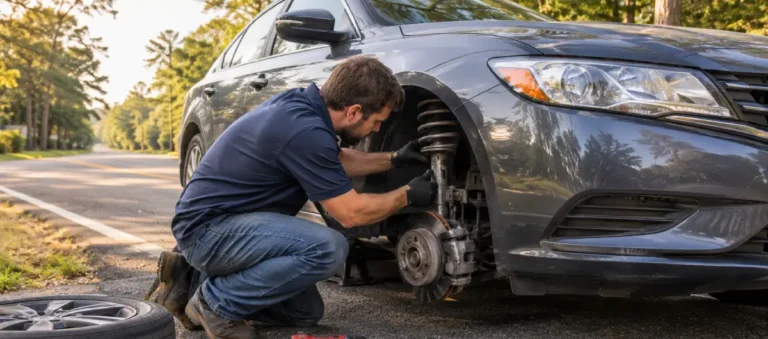
Struts perform the same damping function as shocks, but they also serve as a major structural part of your suspension. A strut houses the coil spring, supports the vehicle’s weight and connects directly to the steering knuckle, so it directly affects your wheel alignment angles and steering responsiveness—which is why the technicians at Discount Brakes and More always verify alignment specs whenever servicing front struts.
Why Alabama Roads Can Shorten Suspension Lifespan
Manufacturer estimates of 100,000 miles assume ideal driving conditions. Real-world driving across Huntsville, Decatur, and Madison introduces several environmental and road factors that accelerate wear on your struts and shocks.
Highway Expansion Joints and Daily Commutes
High-speed stretches along I-565 and I-65 feature repetitive concrete expansion joints. Every time your tires hit a seam at 70 mph, the shock piston cycles rapidly, generating internal friction and wearing down seals faster than smooth city driving.
Heat, Humidity, and Seasonal Potholes
Alabama’s prolonged summer heat thins the hydraulic fluid inside shocks and struts, reducing damping efficiency during peak afternoon traffic. When winter rain and sudden temperature drops arrive, water seeps into pavement cracks and creates potholes that deliver harsh vertical impacts to strut mounts and internal valves.
Heavy SUVs, Trucks, and Towing Loads
North Alabama roads are packed with full-size pickups, three-row SUVs, and vehicles hauling boats or trailers toward Wheeler Lake and the Tennessee River. Carrying heavy cargo or towing puts sustained compression stress on rear shock absorbers, often cutting their lifespan to about 50,000 to 65,000 miles.
6 Warning Signs Your Shocks or Struts Are Wearing Out
Because suspension wear happens slowly, drivers unconsciously adjust their steering habits to compensate. Watch for these six telltale symptoms before minor wear turns into a safety hazard:
1. Nose-Diving When Braking
If the front end of your car dips sharply toward the pavement when you press the brake pedal, your front struts can no longer control forward weight transfer. Severe nose-diving can increase your stopping distance by up to 20 percent during sudden highway braking—and puts extra stress on your pads and rotors, leading to premature professional brake repair.
2. Excessive Bouncing After Bumps
After crossing railroad tracks, speed bumps, or bridge transitions, a healthy suspension settles within one smooth motion. If your vehicle continues bouncing two or three times afterward, the internal damping valves are worn out.
3. Cupped or Uneven Tire Wear
Worn shocks allow tires to micro-bounce off the road surface at highway speeds. Over time, this creates scalloped, wavy or “cupped” bald spots around the tread, ruining expensive tires thousands of miles early.
4. Swaying or Body Roll on Turns
When you take curved highway off-ramps or make quick lane changes, worn struts allow excessive side-to-side body roll. Your steering wheel may feel sluggish or require constant small corrections to stay centered in your lane.
5. Visible Hydraulic Fluid Leaks
Look behind your wheels at the cylindrical shock or strut body. A light dust film is normal, but dark, greasy oil streaks running down the outside of the cylinder mean the internal seal has failed and the unit must be replaced.
6. Clunking or Knocking Noises
Hearing a dull clunk or metallic knock when driving over rough pavement often points to worn strut mounts, collapsed rubber bushings or a bottomed-out shock absorber (technicians can also distinguish this from worn wheel hub bearings during an inspection).
How to Check Your Shocks at Home: The 30-Second Bounce Test
You don’t need special tools to do a basic suspension check in your driveway. Follow these three quick steps:
- Park on a flat, safe surface: Engage your parking brake and make sure the vehicle is in park on level ground.
- Press down firmly on one corner: Place both hands on the front fender or rear bumper above the wheel and push down with your body weight, then let go quickly.
- Count the bounces: Watch how the vehicle reacts. If it rises back up and settles immediately, your damping is likely intact. If it rebounds more than 1–2 times, schedule a professional suspension inspection.
Safety Caveat: While the bounce test works well on older sedans and lighter vehicles, stiff modern gas-charged struts and heavy-duty truck suspensions often resist hand pressure even when their internal valves are worn. Always pair a bounce test with a visual inspection for fluid leaks and uneven tire wear.
How Much Does Shocks and Struts Replacement Cost in North Alabama?
Your total shocks and struts replacement cost depends on whether your vehicle uses standard shock absorbers, complete coil-over strut assemblies, or electronic adaptive suspension components.
Regardless of vehicle type, shocks and struts replacement should always be performed in pairs—either both fronts or both rears at the same time. Replacing only one side creates uneven damping, causing your vehicle to pull under braking and handle unpredictably on wet roads.
| Service Type | Average Cost Range | Typical Repair Time |
| Front or Rear Shocks (Pair) | $350 – $650 | 1.5 – 2.5 hours |
| Front Strut Assemblies (Pair) | $600 – $1,100 | 2.0 – 3.5 hours |
| Full 4-Corner Replacement + Alignment | $1,100 – $1,900 | 3.5 – 5.0 hours |
If you are looking for transparent, budget-friendly shocks and struts replacement in North Alabama, Discount Brakes and More offers complete strut, shock, and wheel alignment services backed by straightforward pricing.
Even better, if you already have a written repair quote from another local shop, bring it in—Discount Brakes and More will beat any competitor’s written estimate by 15%. You can explore our full list of automotive services online anytime.
Frequently Asked Questions About Shocks and Struts
1. Can I drive with bad shocks or struts?
You can drive short distances with worn shocks or struts, but it is unsafe to delay repair. Compromised suspension components reduce tire contact with the road, lengthen emergency stopping distances, and increase the risk of hydroplaning during heavy rain.
2. Do I need a wheel alignment after replacing struts?
Yes. Because struts are part of your vehicle’s steering and suspension geometry, replacing them can alter camber and toe angles. A four-wheel alignment ensures your vehicle drives straight and prevents rapid tire wear. Replacing standalone rear shocks generally does not require an alignment.
3. How often should I have my suspension inspected?
Have a technician inspect your struts and shocks, ball joints, and bushings at least once a year or every 15,000 miles. Asking for a visual suspension check during routine brake inspections or tire rotations is an easy way to catch leaks early.
4. Do shocks and struts wear out faster than brakes?
Generally, no. Brake pads typically wear out every 30,000 to 60,000 miles, depending on city versus highway driving, whereas shocks and struts usually last 50,000 to 100,000 miles. However, worn struts force the front brakes to work harder during stops, which can wear out front brake pads prematurely.
5. Is it better to replace complete strut assemblies or just the strut cartridge?
Complete “quick-strut” assemblies—which include a pre-assembled strut, new coil spring and upper strut mount—are usually the best value for shock and strut replacement. They restore the original factory ride height, eliminate noisy, worn mounts and save significant shop labor compared to compressing old springs onto a bare strut cartridge.
6. How do bad struts affect my brakes and tires?
Worn struts allow excessive forward weight shift every time you hit the brakes, putting extra heat and friction on your front brake pads and rotors. At the same time, reduced damping causes tires to bounce subtly on rough pavement, leading to premature cupping and noisy road vibration.
Schedule a Suspension & Brake Check in North Alabama
Keeping your shocks and struts in good shape—ideally checking them around the 50,000-mile mark—protects your tires, sharpens your braking response, and makes daily commutes across North Alabama much smoother.
If your ride feels bouncy, noisy, or unstable on curves, visit Discount Brakes and More at our convenient locations in Huntsville (N Memorial Pkwy), Decatur (Hwy 31 S), or Madison. Contact our team today to schedule a suspension inspection or bring in a competitor’s written quote to save 15% on your repair.