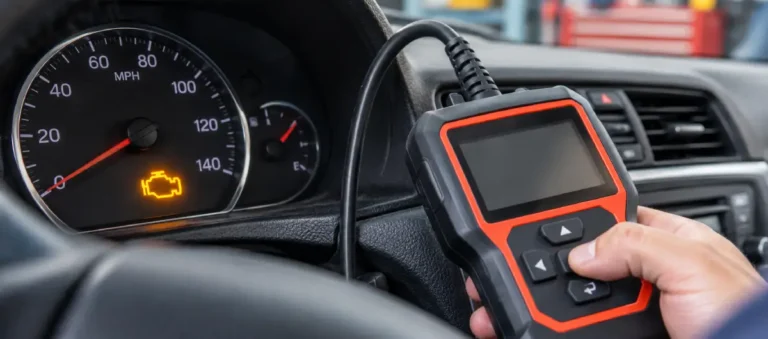
Few sights on a morning commute cause instant stress quite like an illuminated check engine light. Because that single amber symbol can mean anything from a loose gas cap to an internal engine misfire, most drivers are left wondering how much it will cost just to find out what is wrong—and whether it is safe to keep driving.
Ignoring the warning light or guessing at replacement parts often leads to lower fuel mileage, failed emissions checks, and much higher repair bills later. Below is a complete breakdown of what a professional check engine light diagnostic costs, what happens during the inspection, and the five most common repairs drivers face.
Quick Answer: How Much Does a Check Engine Light Diagnostic Cost?
A professional check engine light diagnostic typically costs between $80 and $150, depending on your vehicle make and the depth of testing required. While basic code reading pulls stored error numbers, a complete shop diagnostic includes live sensor data analysis, visual inspection, and pinpoint testing to confirm the exact failed component. The five most common fixes are a loose gas cap, faulty oxygen sensor, worn spark plugs, failing mass airflow sensor, and a clogged catalytic converter.
What Is a Check Engine Light Diagnostic?
When your vehicle’s onboard computer (ECU) detects an issue with the engine, transmission, or emissions system, it logs a Diagnostic Trouble Code (DTC) and turns on the dashboard warning light. A check engine light diagnostic is the step-by-step process a technician uses to trace that code back to its root physical cause.
Many drivers confuse a free code scan at an auto parts store with a true diagnostic test. Here is why they are different:
- Code Reading Only Identifies a Circuit or Symptom: A code such as P0171 (System Too Lean) tells you the engine is getting too much air or too little fuel. It does not tell you whether the culprit is a cracked vacuum hose, a dirty mass airflow sensor, or a weak fuel pump.
- Pinpoint Testing Prevents Wasted Money: Replacing parts based solely on a code printout often leads to “parts-cannon” guesswork. A certified technician reads freeze-frame data (the exact speed, engine temperature, and RPM when the fault happened), checks live voltage streams, and tests the suspect component directly before recommending a repair.
Check Engine Light Diagnostic Cost Breakdown
Diagnostic pricing varies based on how hidden or complex the electrical or mechanical fault is. Most drivers fall into the standard diagnostic tier, though intermittent wiring faults or evaporative emission leaks can take extra bench time.
| Diagnostic Tier | Average Cost Range | What Is Included | Best For |
| Basic OBD-II Code Scan | $0 – $50 | Pulling stored trouble codes and clearing basic history | Quick initial check for a steady light |
| Standard Shop Diagnostic | $80 – $150 | Full OBD-II scan, freeze-frame review, live sensor data & pinpoint component test | Confirming the exact failed part before buying repairs |
| Advanced Electrical / Smoke Test | $150 – $250+ | EVAP system smoke machine testing, wiring harness tracing & oscilloscope testing | Hidden vacuum leaks, intermittent stalling, or complex electrical faults |
Tip for local drivers: Always ask whether your repair shop applies the diagnostic fee toward your final repair bill if you approve the recommended work. At Discount Brakes and More, our technicians review all findings with you upfront so there are never surprise charges.
Top 5 Most Common Check Engine Light Fixes
Once the diagnostic scan pinpoints the issue, most engine repair and diagnostics work falls into five routine categories.
1. Loose, Damaged, or Missing Gas Cap
Your fuel system relies on a sealed pressurized loop called the Evaporative Emission Control (EVAP) system to keep fuel vapors from escaping into the atmosphere. If the gas cap is not clicked tight after refueling—or if its rubber O-ring seal has cracked with age—pressure drops and triggers an EVAP leak code (such as P0455 or P0457).
- Symptoms: Usually none, aside from the dashboard light and occasionally a faint fuel smell near the rear fender.
- Average Repair Cost: $0 – $35 (tightening the cap is free; a replacement OEM cap typically costs under $35).
2. Faulty Oxygen (O2) Sensor
Oxygen sensors monitor how much unburned oxygen leaves your engine through the exhaust pipe. Your car’s computer uses this reading in real time to adjust the air-to-fuel mixture. Over time, O2 sensors become coated in carbon and ash, slowing down their response time.
- Symptoms: Noticeable drop in gas mileage (often up to 20% to 40% worse), rough idling, or failed emissions testing.
- Average Repair Cost: $150 – $350 per sensor (most modern vehicles have two to four sensors).
3. Worn Spark Plugs or Ignition Coils
Spark plugs ignite the air-fuel mixture inside each cylinder thousands of times per minute, while ignition coils deliver the high voltage needed to create that spark. When plugs wear past their service interval or a coil fails, the cylinder misfires, triggering codes like P0300 through P0308. Staying on top of routine engine tune-ups is the easiest way to prevent misfire-related check engine lights.
- Symptoms: Engine shaking at stop signs, sluggish acceleration, hard cold starts, and poor fuel economy.
- Average Repair Cost: $150 – $400 (4-cylinder engines cost less than V6 or V8 engines with harder-to-reach rear plugs).
4. Failing Mass Airflow (MAF) Sensor
Located between your air filter box and the engine intake, the Mass Airflow sensor measures the exact volume and density of air entering the engine so the computer can inject the right amount of fuel. A dirty air filter or oil residue can contaminate the sensor’s delicate heated wire.
- Symptoms: Engine hesitation when pressing the gas pedal, stalling right after startup, or surging at highway speeds.
- Average Repair Cost: $200 – $400 (occasionally resolved with specialized MAF sensor cleaner if caught early).
5. Clogged or Failing Catalytic Converter
Your catalytic converter transforms toxic exhaust gases—like carbon monoxide and hydrocarbons—into less harmful emissions. Catalytic converters rarely fail on their own; they usually overheat and melt internally because a driver ignored worn spark plugs or a faulty oxygen sensor for too long.
- Symptoms: Rotten egg (sulfur) smell from the exhaust, severe loss of power when climbing hills, and code P0420.
- Average Repair Cost: $900 – $2,500+ depending on vehicle make and whether federal or California-compliant (CARB) parts are required.
Steady vs. Flashing Check Engine Light: When to Stop Driving
Not every check engine diagnostic requires a tow truck, but knowing the difference between a steady light and a blinking light can save your engine from severe damage.
- Steady Check Engine Light: The computer has detected a non-emergency fault—often an emissions sensor or minor fuel-trim issue. Your car is generally safe to drive for short, normal trips, but you should schedule an appointment at a full-service auto repair shop within a few days so a minor $200 sensor fix does not turn into a $1,500 catalytic converter replacement.
- Flashing Check Engine Light: Stop driving immediately. A blinking light indicates an active, severe engine misfire that is dumping raw, unburned fuel directly into your hot exhaust system. Driving even a few miles with a flashing light can superheat and destroy your catalytic converter or cause internal engine damage. Pull over safely and arrange a tow to your repair shop.
Why Huntsville Drivers Trust Discount Brakes and More for Engine Diagnostics
Whether you are commuting along Memorial Parkway, heading toward Research Park, or driving across the Tennessee Valley, a sudden warning light shouldn’t mean guesswork or inflated repair bills. If you have been searching for reliable engine diagnostics near me in North Alabama, our local shops make getting an honest answer straightforward.
At Discount Brakes and More, our technicians pair factory-grade OBD-II diagnostic equipment with hands-on mechanical inspection. We walk you through the exact trouble codes, explain what failed in plain language, and provide a transparent written estimate before starting any repair.
We provide fast, accurate engine diagnostic services and complete engine repair and diagnostics at three convenient North Alabama locations:
- Discount Brakes and More – Huntsville, AL
- Discount Brakes and More – Madison, AL
- Discount Brakes and More – Decatur, AL
Need your check engine light checked today? Stop by your nearest Discount Brakes and More shop or contact us online to schedule a fast, honest diagnostic appointment.
Frequently Asked Questions (FAQs)
1. How long does a check engine light diagnostic take?
Most standard check engine light diagnostics take 30 to 60 minutes. If your vehicle has an intermittent electrical fault or a hidden vacuum leak that requires smoke testing or wiring tracing, a thorough check engine light diagnostic may take up to 90 minutes.
2. Will disconnecting my car battery reset the check engine light?
Disconnecting the battery temporarily clears the dashboard light, but it does not fix the underlying problem. Once your vehicle completes a few drive cycles, the light will turn back on—and disconnecting the battery erases valuable freeze-frame data that technicians at Discount Brakes and More use to diagnose the fault faster.
3. Can a bad battery or alternator trigger a check engine light?
Yes. Modern vehicles rely on steady voltage to power dozens of engine sensors. If a weak battery or failing alternator causes voltage drops, sensors can send erratic readings to the computer and trigger false check engine trouble codes.
4. Is it safe to drive with my check engine light on?
If the light is steady and your car drives normally without shaking, overheating, or losing power, it is safe to drive short distances until your check engine diagnostic appointment. If the light is flashing, pull over safely and turn off the engine immediately to prevent severe catalytic converter damage.
5. Why did my check engine light turn off on its own?
If a temporary condition—such as a loose gas cap that you later tightened or a tank of low-quality fuel—resolves itself, the computer may turn the light off after several consecutive trouble-free drive cycles. However, the code remains stored in the computer’s history and can still be scanned.
6. Why shouldn’t I just buy the part listed on a free auto parts store printout?
A free code printout only lists the system or sensor reporting an abnormal reading, not the confirmed root cause. For example, an oxygen sensor code can actually be caused by an exhaust leak or a vacuum leak—meaning buying a new O2 sensor will not turn off the light.